
MICR CODE LOOKUP
Find Official Bank MICR Codes & Branch Details
MICR CODE LOOKUP: Find Indian Banks MICR Code Online
Online banking has made everyday money tasks simpler. You can use mobile apps, UPI, and other digital tools to pay, check balances, and move funds. Still, some older banking details matter for certain transactions. One key detail is the Indian Banks MICR Code.
If you have ever checked a cheque, you might have noticed a line of numbers near the bottom. Those digits are not random. They help with cheque sorting and processing. They also point to the bank and the branch in a way the system can read.
Many users type MICR CODE LOOKUP online when they need the MICR code for a specific branch. You may need it while filling out a form, reading a cheque, confirming branch information, or just trying to make sense of your bank details. The right Indian Banks MICR Code keeps things fast and lowers the chance of errors.
In this guide, you will learn what a Indian Banks MICR Code Lookup is. You will also see how it works, where to find it, and why it matters. It will also show you how to search for the MICR code of an Indian bank branch.
What Is a MICR Code?
MICR means Magnetic Ink Character Recognition. A MICR code is a set of numbers tied to a bank branch. It is used to help sort and read cheques and other banking papers.
In India, MICR codes are usually nine digits long. Those digits are arranged so they point to the area, the bank, and the exact branch. Since the parts of the code each carry meaning, you need the right MICR when a bank asks for it.
The Reserve Bank of India shares MICR details for branches. This includes the bank name, branch name, place, and the MICR Code itself. So if you need to check a MICR code, the RBI list is a good place to start.
MICR is not the same as an IFSC code. Both can relate to branch data, but they are used in different ways. That mix-up happens often with people who are still learning online banking. An IFSC code is used for electronic payments. NEFT and RTGS are common examples. A MICR code is used in cheque handling. It supports the reading and identification of branch details during cheque processing.
So do not treat an IFSC code and a MICR code as if they can swap. Use the code that matches the task your banking form or system asks for.
Why Do People Need a MICR CODE LOOKUP?
Trying to MICR code Lookup by hand can be a hassle. This is true when you do not have a cheque book close by. It is also common when you are not sure which branch you should use. That is why online MICR lookup sites can help. You avoid flipping through pages. You also avoid reading long banking forms. Instead, you enter a bank name and a branch or location. Then you get the matching banking details. A good MICR CODE LOOKUP should help you pick the right branch. Accuracy matters most. If you use a code from a different branch, it may not work for the payment you want to make. Some cities have multiple branches under the same bank. Their names can look alike at a quick glance. Yet the branch codes and MICR codes can still be different. So, it is smart to confirm the exact branch name and its location before you enter a MICR code.
Where Can You MICR Code lookup?
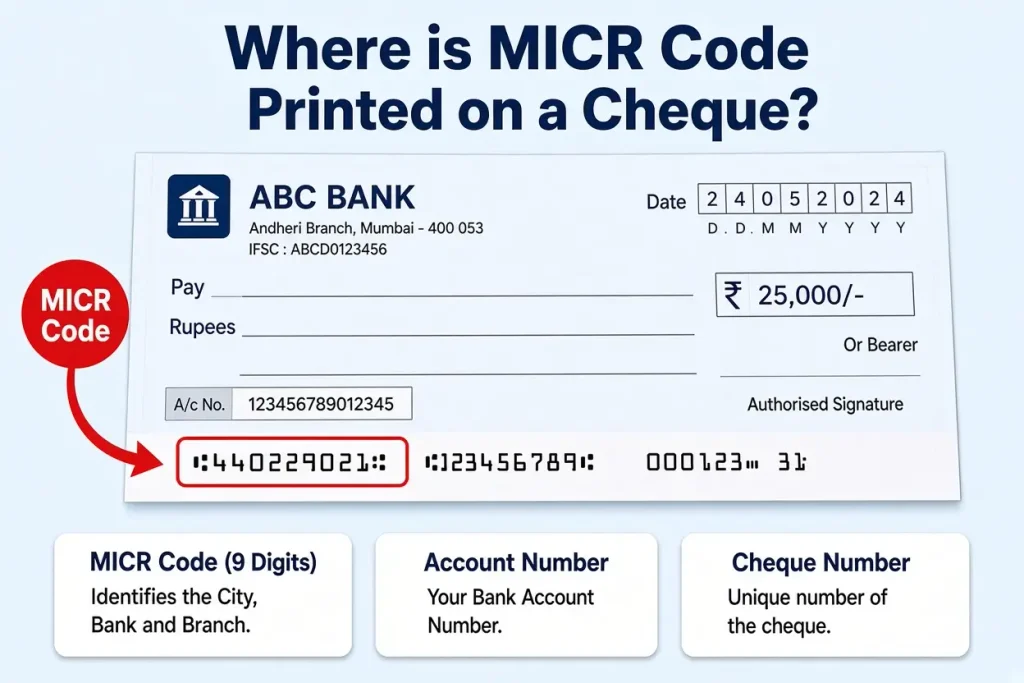
Check your bank cheque first. In many cases, the MICR line is printed near the bottom part of the cheque leaf. It sits along with other machine readable banking details.
Still, not everyone has a cheque book on hand. You might have opened an account recently. You might have misplaced an older cheque book. Or you may need the MICR code for a branch other than the one on your existing cheques. If that happens, an online lookup can be easier. You search for the bank and branch details. After that, you compare the results with what your bank shares or with an official reference. The RBI has also shared documents that list MICR codes. These materials include bank name, branch name, and location details. RBI’s MICR list includes branch-level entries with nine digit MICR codes.
For official regulatory and banking information, readers can also visit the Reserve Bank of India (RBI) website.
How Does a MICR Code Work?
MICR code structure helps you tell if the banking details you see are the right kind. In India, a MICR code usually has nine digits. The first set of three digits points to the city area. The next three digits relate to the bank. The last three digits point to the branch.
One sample format is: 123456789
Those nine digits are not just made up. Each part is meant to show a specific part of the banking setup. You should not try to build a MICR code on your own. Check the exact code instead. Even when you know the location and the bank, the remaining digits can be wrong if you guess. A lookup tool exists to show the real code for a specific branch. It is meant for finding, not guessing.
MICR Code vs IFSC Code
MICR and IFSC are not the same. Still, many people look for both terms at the same time. An IFSC code is used for electronic fund transfers in India. It is made from letters and numbers. It has a different pattern than a MICR code. A MICR code is only numeric in the nine-digit form. It is linked to a branch and has been used for cheque handling. A simple way to keep them apart is this. MICR is tied to cheque and MICR style processing. IFSC is used for electronic transfer identification. If you are looking for IFSC information instead, you can use the IFSC Codes Finder to find Indian bank branch information.
Having both types of information available can be particularly useful when managing different banking requirements.
Is the MICR Code the Same for Every Branch?
A bank can run several branches. Each branch may use a different MICR code. So, picking the right branch matters a lot during a MICR code lookup. It is not just a small step. A big bank might have branches across Delhi, Mumbai, Kolkata, Chennai, and other major cities. If you search only using the bank name, you may miss the correct match. You should also check the branch name and the area. This step becomes even more important when two branches sound alike. It also matters when a bank has more than one branch in the same postal area or in the same city.
If you already have a cheque from that branch, you can compare what you find online with what is printed on the cheque. That can help confirm the details.
Why MICR Code Accuracy Counts
You should enter banking details with care. One wrong digit can point to the wrong branch. This does not always mean money is lost right away. Still, it can lead to delays, failed processing, or extra checks later. For best results, verify the bank name, branch name, city, and MICR code as one set. Do not copy a number without checking the nearby details.
If you can, confirm key banking facts with your bank or an official source. RBI published data can be helpful for checking MICR related branch records.
How to Use a MICR CODE LOOKUP Tool
A MICR lookup tool can be simple to use. You usually type in or pick the bank, then add the state, city, or branch. After that, the MICR code you need should be shown. If you share more details, the tool can narrow the results faster. When you know the exact branch name, choose it. Don’t rely only on the city if you can help it.
Take this example. You want the MICR code for a bank branch in Mumbai. That bank may have many branches there. If you search with only the bank name and the city, you might get more than one match. When you add the branch name, the list gets tighter and the match is clearer. Once a result appears, pause and review it. Confirm that the bank name, the branch name, and the place shown are the ones you actually need. This quick check can prevent issues. It matters when the MICR code will be used for a key banking step.
Can you find a MICR code without a cheque?
Yes. A cheque is one common way to see a MICR code. Still, it is not the only way. You can use a bank directory online and look up the code for the branch. You can also check official banking sources to confirm what you found. This can help if you do not have a cheque book. It also helps if you need details for a branch other than your usual one. Even so, banking details can shift. So it is smart to confirm the information again before you use it for any money transaction.
Do MICR codes still matter?
Digital banking has changed how people move money. Still, MICR codes are used in India, mainly for cheque handling and to identify a branch. You can see this in RBI materials. RBI banking data keeps MICR details in published records. RBI forms and data fields also mention MICR code and branch related information.
At the same time, everyday banking habits keep shifting. Many people now use net banking, mobile apps, and other payment methods. Because of that, IFSC codes can show up more often than MICR codes for many users. Even with these changes, if a form or a cheque process asks for a MICR code, you should enter the right branch specific code.
Last thoughts
A MICR code lookup helps people get the right MICR code for a branch in India. It saves time compared to going through long records. You can search using the bank name, the branch, and the place. One key point to keep in mind is that MICR and IFSC codes do not do the same job. Use the code that the request is asking for. Do not swap them.
When you look up a MICR code, do not trust the first result you see on a website. Confirm the bank name, the branch name, and the location. If the transaction matters, double check with the bank or with an official source, like the Reserve Bank of India. With correct branch details and a dependable lookup, getting a MICR code can be quick and easy as part of your banking tasks.
Frequently Asked Questions About MICR CODE LOOKUP
1. What is a MICR code?
A MICR code is a nine-digit numeric code associated with a bank branch in India. MICR stands for Magnetic Ink Character Recognition and is traditionally used in cheque processing and branch identification.
2. What does MICR stand for?
MICR stands for Magnetic Ink Character Recognition. The technology is designed to allow banking documents such as cheques to be read and processed electronically.
3. How many digits are in an Indian MICR code?
An Indian MICR code generally contains nine digits. Different sections of the code identify the location, bank and specific branch.
4. Is MICR code the same as IFSC code?
No. MICR and IFSC are different banking codes. MICR is generally associated with cheque processing, while IFSC is primarily used for identifying bank branches in electronic fund transfers.
5. Where can I find my bank’s MICR code?
You can often find the MICR code on your bank cheque. It may also be available through a reliable online MICR lookup service, your bank’s official channels or published banking information.
6. Can I find a MICR code without a cheque?
Yes. You do not necessarily need a cheque to find a MICR code. You can search using the bank and branch details through a reliable banking directory or verify the information with the bank or official sources.
7. Does every bank branch have a different MICR code?
Generally, MICR codes identify specific bank branches, so different branches can have different MICR codes. Always check the exact branch and location before using a code.
8. Can I use an IFSC code instead of a MICR code?
No. You should use the code specifically requested for the banking service or transaction. IFSC and MICR serve different purposes and should not be treated as interchangeable.
9. Why is it important to check the correct MICR code?
Using incorrect banking information can cause processing problems or delays. Checking the bank name, branch name, location and MICR code together helps reduce the possibility of using the wrong branch information.
10. Where can I verify MICR code information?
You can verify MICR information through your bank and official banking sources. The Reserve Bank of India also publishes MICR-related branch information, making its official website a useful source for verification.